Signalling Concepts
Signalling ensures the safe movement of trains on the network. Because trains run on fixed rails and have long braking distances, drivers rely on signalling systems to know the line ahead is safe.
The Principle of Train Separation
The core function of railway signalling is to keep trains apart. This is traditionally achieved through 'block signalling'. The railway line is divided into sections called blocks. The fundamental rule is that only one train is permitted in a block at any one time.
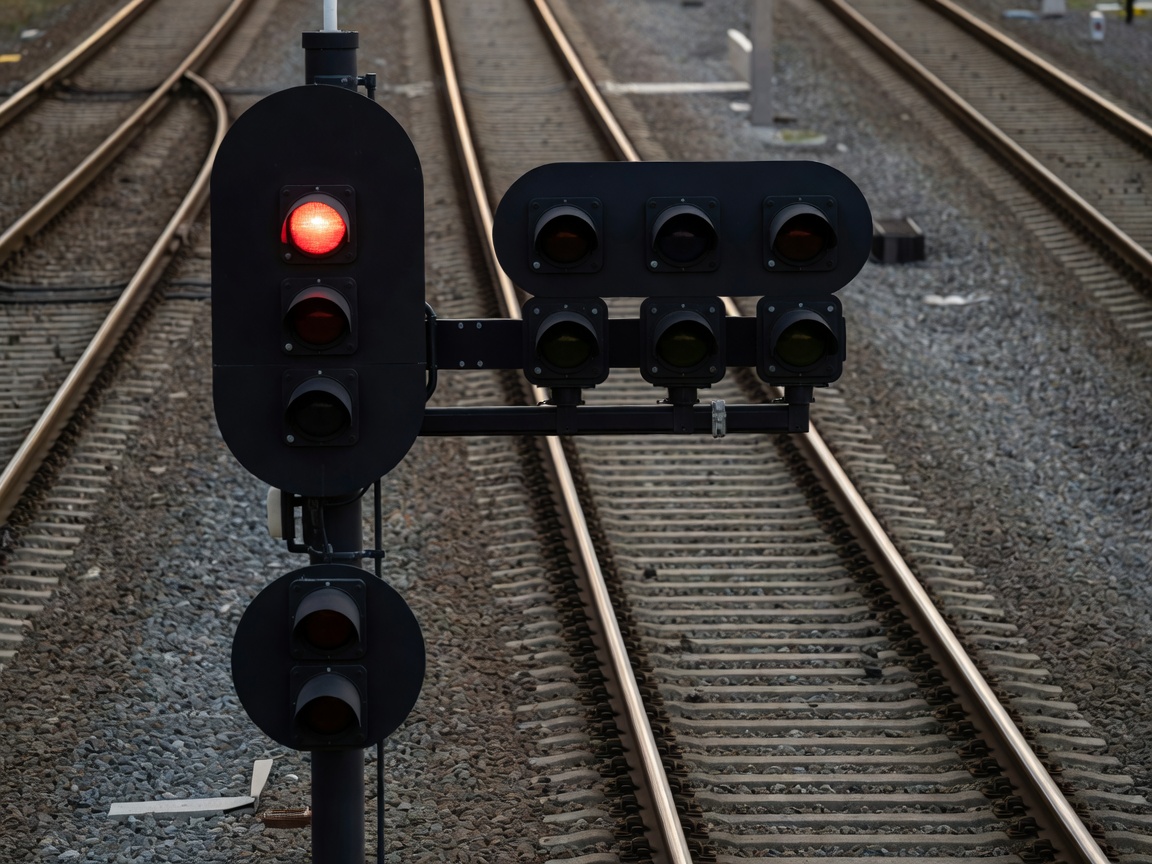
When a train enters a block, the signal protecting that block turns red (danger). As the train progresses into subsequent blocks, the signals behind it step up through warning aspects (e.g., yellow) to indicate to following trains that they must prepare to stop.
Interlocking
Interlocking is the logic system that prevents unsafe states. Before a signal can be cleared to allow a train to proceed, the interlocking system verifies that:
- The route ahead is physically clear of other trains.
- All sets of points (switches) are set in the correct position for the route.
- The points are securely locked in that position.
- No conflicting routes have been set for other trains.
If these conditions are not met, the interlocking hardware or software will refuse to clear the signal.
Modern Digital Signalling (ETCS/CBTC)
Traditional signalling relies on lineside lights. Modern digital systems, such as the European Train Control System (ETCS) or Communications-Based Train Control (CBTC) for metros, move the signals into the driver's cab.
These systems calculate a dynamic 'movement authority' for each specific train, taking into account its speed, braking capability, and the position of the train ahead. This allows for closer, safer running and increased track capacity without the need for fixed physical blocks.
Fail-Safe Engineering
Railway signalling is designed around the fail-safe principle. If a component fails (e.g., a wire breaks, a bulb blows, or power is lost), the system must default to its most restrictive state—turning signals to red to halt traffic and maintain safety.